It is 6.12pm. You are both home, the fridge door is open, and neither of you has said the words yet — but you are both thinking them. What do you feel like? I don't mind. What do you feel like? Twenty minutes later a delivery app has made the decision on your behalf, and dinner costs forty-odd dollars you did not plan to spend.
That loop is not laziness. It is decision load landing at the precise hour of the day when you have the least of it left. And it is worse for two people than for one, because now the decision needs a quorum.
The 6pm loop is a planning problem, not a willpower problem
Couples who cook together rarely fail at the cooking part. You can both chop. One of you is decent with a pan. The failure happens hours earlier, in the gap where nobody decided anything, and it compounds: no decision means no shopping list, no shopping list means no ingredients, no ingredients means the only real option at 6pm is whatever can be delivered.
A meal planning app is not there to teach you to cook. It is there to move the decision to a moment when it is cheap — a quiet ten minutes on Sunday — so that 6pm becomes execution instead of negotiation. That is the whole job. Judge any app you try against that one sentence.
Why apps built for families quietly fail two people
Most meal planners are built around a household of four or five. That assumption is invisible until it starts costing you money. Family planners optimise for volume: big-batch recipes, weekly shops sized for a crowd, and a single decision-maker (usually one parent) who plans for everyone else.
Two people break all three assumptions. Your volume is small enough that waste is proportionally brutal. Your shop is small enough that a bulk-buy suggestion is actively wrong. And there is no single decision-maker — there are two adults with equal veto rights, which is a completely different problem to solve.
The result is an app that technically works and practically annoys. You plan four dinners, buy a bunch of coriander, use a fifth of it, and throw the rest out on Thursday having also not agreed on Wednesday's meal.
The recipe-serves-four tax
Nearly every recipe on the internet serves four. When you cook for two, you are permanently doing mental arithmetic — halving an egg, guessing at two-thirds of a tin, wondering whether to just cook the whole thing and eat it twice.
This is the single most useful thing an app can do for a couple, and a surprising number do it badly. Proper scaling means the ingredient quantities change and the grocery list changes with them. Scaling that only adjusts the display, then adds a full recipe's worth of ingredients to your list, is worse than no scaling at all, because now you trust it.
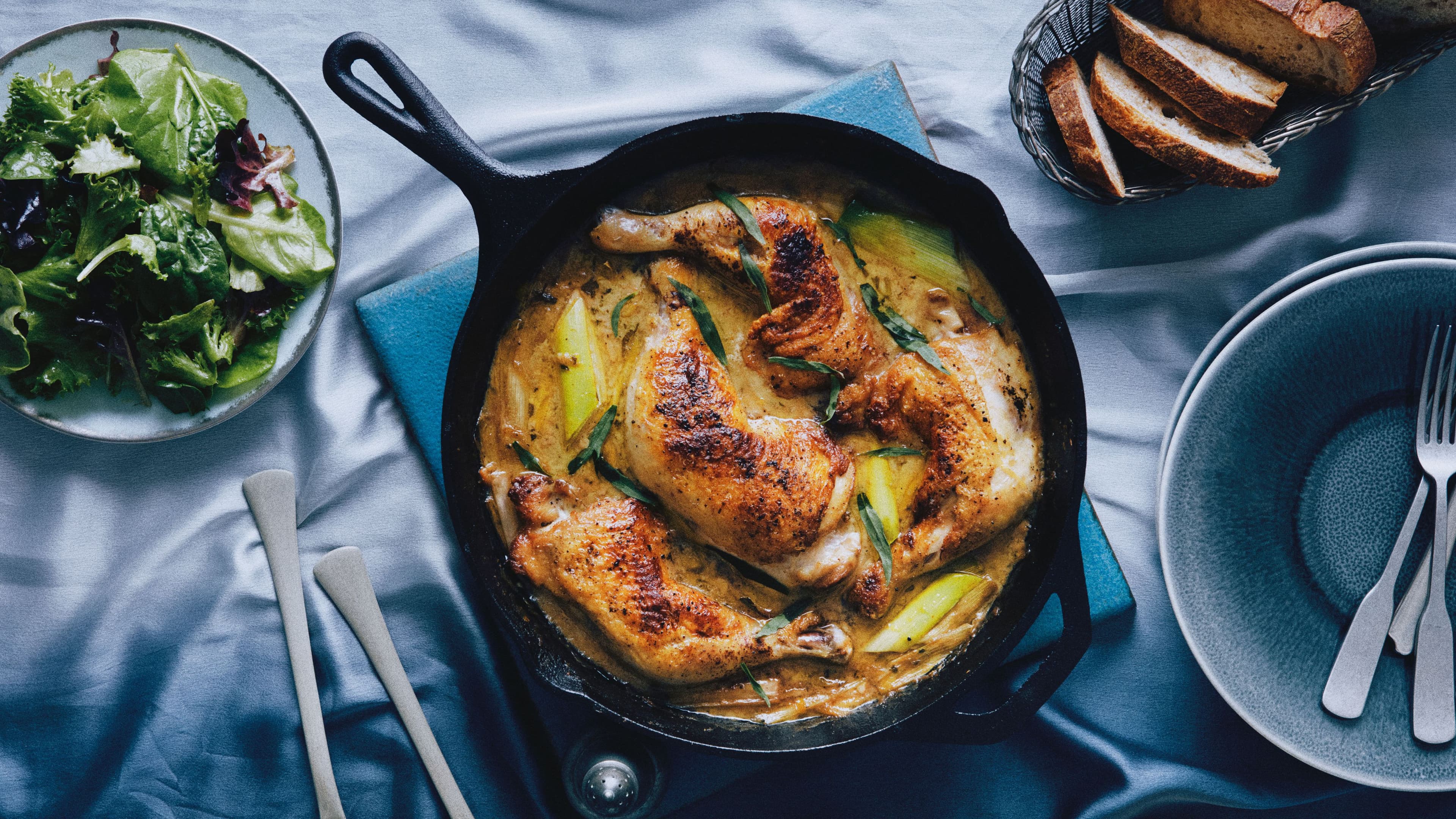
Test it on something with awkward amounts. A braise like Creamy Cider-Braised Chicken and Leeks is a good stress test: halve it and see whether the app tells you to buy one leek or three, and whether it remembers that you already have cider in the door of the fridge.
Two palates, one plan
The other thing family planners miss: two adults, two sets of preferences, and no hierarchy to resolve them. One of you would happily eat noodles four nights running. The other has opinions about repetition. Someone does not like coriander, and it is not negotiable, and that is fine.
What helps is not a preferences questionnaire. It is visibility. When both of you can see the week laid out — and both of you can move things around — the negotiation stops being a conversation at 6pm and becomes a shared object you each poke at during the week. Disagreements happen on Tuesday afternoon, in ten seconds, instead of at the fridge door.
The practical shape of this is a shared library and a shared plan, not two accounts that email each other. If your partner has to ask you to add something, the app has installed you as middle management in your own kitchen.
What to look for — the short list
Five things matter for two people. Most of the rest is decoration.
| What to look for | Why it matters when there are two of you |
|---|---|
| Real portion scaling | Halves the recipe and the shopping list, so you stop buying for a family you do not have |
| A genuinely shared plan | Both of you can add and move meals; neither of you becomes the household planner by default |
| Automatic grocery list | The plan becomes a shop without anyone retyping it — the step where most systems die |
| Save any recipe by URL | Your food already lives on blogs and in your camera roll; an app with its own walled recipe set will not survive contact with reality |
| Flexible weeks | Three dinners and two "we will wing it" nights is a normal week, and the app should not scold you for it |
Notice what is not on that list: calorie targets, macro breakdowns, streaks, and anything that gamifies dinner. Those serve a different job. If you want a fuller run-through of the tool landscape, we went deep on it in best meal planning app Australia.
The grocery list is where planners live or die
Here is the honest test of any meal planner: how many manual steps sit between "we picked five dinners" and "we are standing in the shop knowing what to buy"? If the answer is more than zero, the system will quietly stop being used within three weeks. Not dramatically — you will just skip it one busy Sunday and never go back.
A good list merges duplicates across recipes, groups by aisle so you are not zig-zagging, and is visible to both phones at once so whoever is closest to the shops can do it. That last one is the underrated part. Half the value of a shared list is that it removes the phone call from aisle six.
We wrote a full walkthrough of getting this working in how to set up a shared grocery list — it is the piece of the system most couples get value from first, and the one worth setting up properly before anything else.
Splitting the work without turning into a manager
Cooking together sounds romantic and is mostly logistics. The couples who sustain it are not the ones with the best knife skills; they are the ones who split the load in a way nobody has to keep score of.
A plan both of you can see does most of that work silently. The person who shops does not need briefing. The person who cooks does not need to ask what was agreed. Nobody is remembering on anyone else's behalf, which is the invisible labour that quietly sours a lot of shared kitchens.
If you already batch-cook, the same principle applies with more leverage — we covered the mechanics of that in meal prep for two. And if your fridge tends to hide things until they are science experiments, pantry tracking plugs the gap between what you own and what you buy again anyway.
How to trial one in a single week
Do not evaluate a meal planner by reading its feature list. Run one week, properly, and watch for the friction.
Pick four dinners — not seven, you will not cook seven. Scale each to two people. Push the plan to a grocery list and do one shop from it. Then cook, and notice the specific moments where you had to leave the app and do something manually: retyping an ingredient, texting your partner a photo of the list, working out quantities on your fingers.
Something quick and forgiving is a good first week. JUICY Pesto Pasta! and Honey Garlic Glazed Salmon both scale cleanly to two and do not punish a late start.
At the end of the week, one question decides it: was 6pm easier? Not "did you use every feature". Just that.
What we would honestly skip
Nutrition tracking, unless you actually want it — bolting a food diary onto dinner is how planning starts to feel like homework. Rigid seven-day calendars, because real weeks have leftovers and last-minute plans and a Thursday where you both give up. Anything that requires both of you to adopt a new habit at the same time; one of you will start, and the app has to be useful for that person alone or it will not survive week one.
And be wary of any planner that makes its own recipes the centre of gravity. Your food already lives somewhere — a blog you both trust, a page you screenshotted, your nan's handwriting. The app's job is to hold what you already love, not to sell you a catalogue.
Where slrp sits
We built slrp for exactly this shape of problem: two people, one kitchen, a shared library that either of you can add to by pasting a URL, a plan that is flexible rather than a rigid grid, and a grocery list that falls out of the plan without anyone retyping it. Scaling adjusts the list, not just the display. Both partners see the same thing, so neither of you ends up as the household planner by default.
It will not make you a better cook. It moves the hardest decision of the day to a calmer hour and makes sure the ingredients are in the house when you get there. Most weeks, that is the whole difference between cooking together and ordering in.
If the 6pm loop sounds familiar, that is the thing worth fixing first — and it is a planning fix, not a cooking one.